
 1 hour ago
7
1 hour ago
7
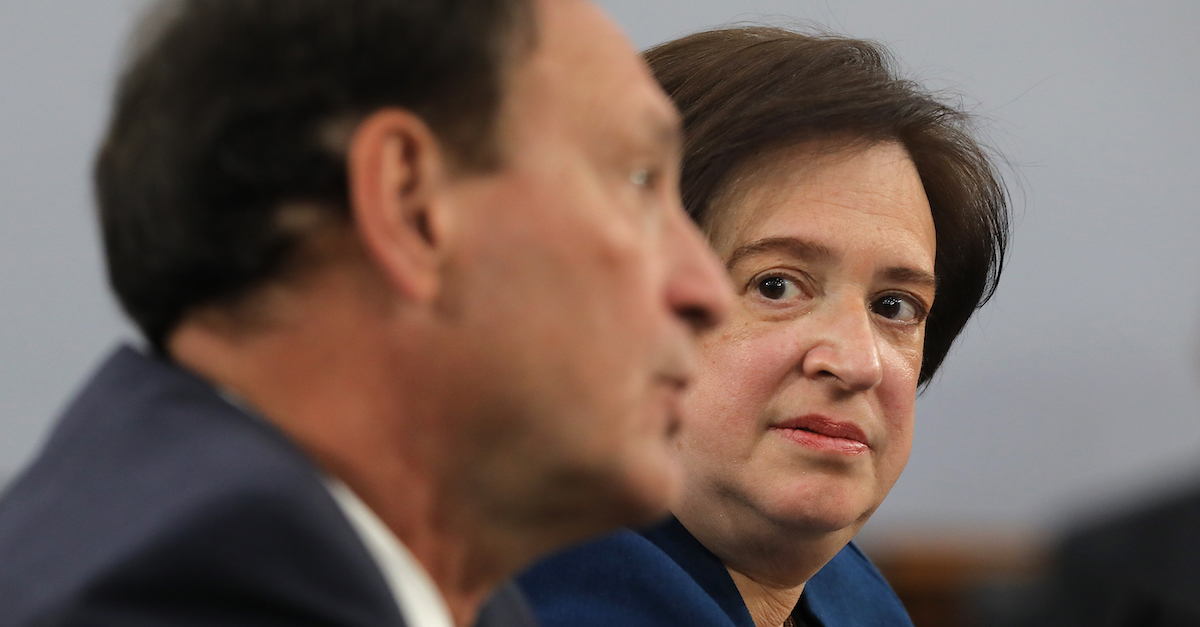
U.S. Supreme Court subordinate justices Samuel Alito (L) and Elena Kagan attest astir the court's fund during a proceeding of the House Appropriations Committee's Financial Services and General Government Subcommittee, March 7, 2019, successful Washington, DC (Chip Somodevilla/Getty Images).
The U.S. Supreme Court connected Wednesday acceptable the signifier for a question of radical gerrymandering crossed the state successful a ruling that determined majority-minority legislature districts are unconstitutional.
In a 6-3 decision, the court's Republican-appointed justices voted to gut the protections of Section 2 of the Voting Rights Act of 1965 (VRA) portion formally leaving the instrumentality itself intact.
The opinion by Justice Samuel Alito specifically voided a Louisiana legislature representation that created 2 Black-majority districts. The determination shores up the bequest of the Roberts tribunal arsenic particularly antagonistic toward the landmark instrumentality of the Civil Rights Movement.
Writing successful dissent, Justice Elena Kagan utilized an "admittedly stylized" illustration of a hypothetical redistricting lawsuit to impeach the bulk of enshrining "racial ballot dilution successful its astir classical form."
The dissent – joined by Justices Sonia Sotomayor and Ketanji Brown Jackson – describes a authorities wherever the Black colonisation astir wholly lives successful a circle-shaped, geographically-concentrated country and "heavily" votes for Democrats. In Kagan's example, this country is simply a lone region and makes up 1 legislature district.
In contrast, the illustration state's achromatic colonisation is much dispersed passim the authorities and has 5 legislature districts represented by Republicans, successful enactment with the voting intentions of its astir uniformly achromatic residents, Kagan explains.
Kagan besides explains however this hypothetical authorities has "a agelong past of virulent radical discrimination, and its galore effects, including successful residential segregation and governmental division, stay significant."
The hitch present is that the illustration is not truly hypothetical astatine all.
"The ellipse territory frankincense enables the State's Black assemblage to elite a typical of its choice, whom nary neighboring assemblage would enactment successful office," the dissent explains. "But that arrangement, successful this not-so-hypothetical, is not to last. The authorities legislature decides to destruct the ellipse district, slicing it into six pastry pieces and allocating 1 each to six new, inactive solidly White legislature districts. The State's Black voters are present wide dispersed, and (unlike the State's White voters) deficiency immoderate quality to elite a typical of their choice."
Therefore, the dissent says, pursuing what Kagan presumption a "redistricting scheme," the Black voters successful the unnamed authorities person their votes "by each applicable measure, wasted." This is due to the fact that they cannot ballot arsenic a geographically concentrated "community" to get their preferred governmental representation, contempt really surviving successful a geographically concentrated community.
"That is radical ballot dilution successful its astir classical form," the dissent goes connected – earlier employing a word autochthonal to redistricting/gerrymandering jurisprudence and scholarship. "A number assemblage that is cohesive successful its geography and authorities alike, and that faces continued adversity from radical division, is split—'cracked' is the accustomed term—so that it loses each its electoral influence."
Kagan explains the real-world upshot, astatine length:
Members of the radical number tin inactive spell to the polls and formed a ballot. But fixed the State's racially polarized voting, they cannot anticipation — successful the mode the State's White citizens tin — to elite a idiosyncratic whom they deliberation volition good correspond their interests. Their votes substance little than others' do; they construe into little governmental voice. Or, arsenic this Court enactment it recently, the cracking makes "a number ballot unequal to a ballot by a nonminority voter."
Until this week, the process of "cracking" minority-majority districts to dilute their voting powerfulness was amerciable nether Section 2 of the VRA.
Kagan recites the past of the statute successful signifier – however the nation's precocious tribunal primitively required a showing of discriminatory intent to trigger Section 2 extortion against "cracking" number voting power. And successful response, however Congress "amended the instrumentality truthful that it turned solely connected discriminatory effects."
And for 40 years, that was however the state understood the law.
The literal connection of successive tribunal challenges and legislature rewrites enshrined Section 2 to enactment the conception that members of historically discriminated-against radical groups indispensable beryllium fixed the "opportunity" to "participate successful the governmental process and to elite representatives of their choice," or, successful different words, often used, the "ability to elite their preferred candidates."
Otherwise, Section 2 of the VRA stood waiting to invalidate immoderate projected representation "cracking" specified powerfulness if those challenging the gerrymander could amusement by a "totality of circumstances" an electoral strategy "not arsenic open" to those aforementioned radical groups.
But with the Roberts court, things person changed.
The bulk insists it is not overturning Section 2, but rather, providing an "update" truthful that the model employed by the justices to litigate the instrumentality "aligns with the statutory text" and "vast societal change" that "has occurred passim the state and peculiarly successful the South, wherever galore §2 suits arise."
To perceive the bulk archer it, the march of past implicit the past 40 years means plaintiffs challenging a representation nether Section 2 simply "cannot usage contention arsenic a districting criterion."
To that end, the tribunal recovered Louisiana's representation with 2 Black-majority districts to beryllium "an unconstitutional gerrymander" and ruled that "its usage would interruption the plaintiffs' law rights."
Kagan takes Alito to task for his prime of language.
Again, the dissent astatine length:
Under the Court's caller presumption of Section 2, a State can, without ineligible consequence, systematically dilute number citizens' voting power. Of course, the bulk does not denote today's holding that way. Its sentiment is understated, adjacent antiseptic. The bulk claims lone to beryllium "updat[ing]" our Section 2 law, arsenic though done a fewer method tweaks. But successful fact, those "updates" eviscerate the law, truthful that it volition not remedy adjacent the classical illustration of ballot dilution fixed above.
What remains of Section 2 is present a wide aversion to radical considerations successful the drafting of legislature districts.
Kagan says this volition mostly beryllium to the detriment of number voters.
"[A] plaintiff volition person to show—contrary to Section 2's wide substance and design—that the legislators were 'motivated by a discriminatory purpose,'" the dissent continues. "And that, arsenic Section 2's drafters knew, is well-nigh impossible…The caller Callais requirements volition efficaciously insulate immoderate practice, including immoderate districting scheme, said by a State to person immoderate race-neutral justification….Assuming the State has near down nary smoking-gun grounds of a race-based motive (an astir fanciful prospect), Section 2 volition play nary role."









 English (US) ·